Mattress Construction & Compatibility
How Adjustable Bases Interact with Latex Construction
An adjustable base can change more than the angle of your bed. Each time its head or foot section moves, the mattress must flex along with it. Latex is naturally resilient, but the way a particular mattress is layered, enclosed, and supported determines how well it handles that movement. Here’s what to check before pairing a latex mattress with an adjustable base.
Published November 19, 2026
Why construction matters when a bed bends
An adjustable base raises or lowers parts of the sleep surface, usually around the head and knees. The mattress follows those changes, bending at one or more points while remaining supported by the base. For a compatible mattress, that movement should occur without the bed slipping, buckling, separating, or being placed under stress its maker has not approved.
Latex is often described as flexible and springy. Those qualities can help a latex mattress adapt to an angled position, then recover when the base returns flat. But “latex” describes a material, not a complete construction standard. Mattresses with the same broad material label can differ substantially in layer count, thickness, firmness, internal layout, cover design, and manufacturer-approved use.
That distinction is the heart of the compatibility question. A flexible latex comfort layer does not automatically make every mattress beneath it suitable for repeated articulation. The whole mattress—not just the surface material—has to work with the base. Before buying or adjusting either item, compare the mattress maker’s guidance with the base maker’s platform, support, and movement requirements.
The result is a more reliable decision than guessing from a material name, a showroom demonstration, or a general claim that latex bends. Compatibility is a question about a specific mattress paired with a specific base, under the conditions each manufacturer permits.
What happens to a latex mattress on an adjustable base?
When a base lifts, the mattress changes shape with it. In a head-raised position, the section beneath the shoulders and upper torso slopes upward. In a raised-leg position, the lower portion bends as the base supports the knees and lower legs. A zero-gravity setting, where available, changes both areas at once. The mattress needs enough flexibility to follow these contours while staying properly supported.
Latex’s elastic response may help it flex and rebound, but it does not eliminate mechanical forces. At a bend point, the mattress can compress on one side and stretch or shift on the other. If the construction resists bending, if the base does not support it as required, or if the mattress moves out of position, the experience may be uncomfortable and the product may not be used as intended.
Articulation can also affect the way layers sit together. A mattress made of separate, stacked layers may respond differently from one with a bonded or unified core. A quilted cover or outer casing may add structure, while an inner component may affect how the mattress holds its shape. These details are reasons to consult product-specific instructions—not proof, on their own, that a particular mattress will or will not work.
Most importantly, using an adjustable base is not simply a matter of whether a mattress can be bent once. The question is whether its full construction is designed and approved for that use, and whether the base supplies the support the mattress requires through its range of motion.
A closer look at latex mattress layers
Many latex mattresses use more than one layer to balance cushioning and support. A softer upper layer may provide a more yielding surface, while firmer material beneath it supports the body and helps establish the overall feel. Other models use a single latex core or combine latex with different materials. The exact arrangement varies by mattress.
Layer thickness and placement are worth checking because they describe how the mattress is built, but they cannot independently confirm adjustable-base compatibility. A thicker mattress is not automatically unsuitable, and a thinner mattress is not automatically suitable. Likewise, a three-layer design does not guarantee that a mattress will flex well—or poorly. The maker’s stated guidance is the decisive reference.
Pay attention to whether layers are separate, joined, or secured within a casing. Some mattresses allow components to be rearranged or customized; others have a fixed internal build. Where a mattress has separate components, ask whether normal articulation is permitted and whether the layers are intended to stay in place when the bed moves. Do not assume that a removable cover or layered design means the mattress can safely be used on any adjustable base.
Firmness is another detail consumers sometimes overinterpret. A soft-feeling top may seem easy to bend, while a firm surface may seem resistant, but perceived comfort is not a compatibility test. Flexibility, construction, and approved support conditions are separate considerations. A mattress can feel comfortable in a raised position and still be used outside its maker’s stated requirements.
Start with the mattress maker’s compatibility guidance
Before purchasing a base, locate the mattress manufacturer’s current documentation. Look for a direct statement about adjustable bases, articulating frames, or adjustable bed frames. If the language is unclear, ask the manufacturer about the exact model and construction rather than relying on a general answer about latex mattresses.
Check the warranty terms and care instructions alongside the compatibility statement. A warranty may specify the kind of foundation or support system required, and a mattress used on an unapproved base could fall outside those conditions. That does not mean a claim will automatically be denied in every circumstance; it does mean the written requirements should be understood before setup.
Keep a record of the documentation and any model-specific guidance you receive. Product names can refer to different sizes, versions, or configurations, and construction may change over time. Confirm that the information applies to the mattress you own or intend to purchase, not simply to another item from the same brand.
If the mattress is customizable, verify the configuration as well as the model name. Different layer choices or side-specific arrangements may matter to the maker’s guidance. When ordering a mattress in a split configuration, ask whether both sides are approved for use with the intended base and whether any additional setup instructions apply.
Then check the adjustable base itself
Compatibility runs in both directions. Even if a mattress maker approves adjustable use, the base must meet the mattress’s requirements. Review the base manufacturer’s instructions for the permitted mattress types, dimensions, thickness, weight, and support arrangement. Confirm that the mattress fits the moving platform and that the base is rated for the combined load it will carry.
Pay close attention to the base’s support surface. Some adjustable bases use a platform or closely spaced support elements; designs vary. The mattress maker may specify the kind of support it needs, and the base maker may set requirements of its own. Those requirements should be compared directly rather than treated as interchangeable.
Also review how the base moves. A base may have independent head and foot sections, a particular articulation range, or features that change the way it moves. Make sure the mattress is approved for the type of articulation offered by that model. Do not assume that every adjustable base has the same motion, support layout, or limits.
Bed frames, headboards, footboards, and nearby furniture can introduce practical clearance issues. The base needs room to articulate without hitting a wall, frame component, or stored item. Follow the base maker’s setup instructions and keep the moving parts clear. Never make adjustments that interfere with the base’s movement, safety features, or required support.
A relevant example: a customizable latex mattress
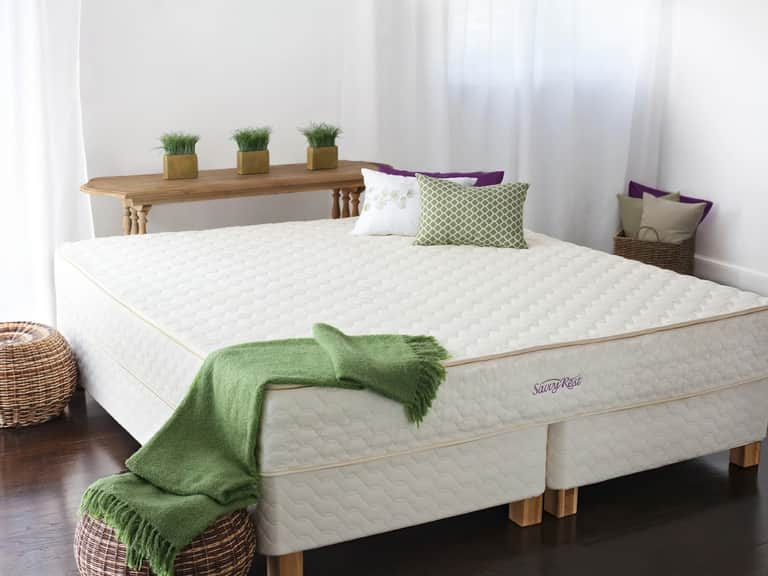
The Savvy Rest Serenity Latex Mattress illustrates why product-specific details matter. It is described as a 10-inch mattress with three customizable latex layers, an organic cotton casing, and organic wool quilting. Its product information states that it may be used on an adjustable bed base. That is useful model-specific guidance, but it should still be read alongside the instructions for the exact adjustable base being considered.
The Serenity’s customizable layer choices make it especially important to confirm that the information applies to the ordered configuration. Its product details describe choices among soft, medium, and firm latex layers, and different arrangements can create different feels. The general statement of adjustable-base compatibility is a starting point for a buyer, not a substitute for checking the mattress and base requirements together.
For any latex mattress, whether customizable or fixed, a product description should be treated as one piece of the compatibility check. Read the full care and warranty documentation, confirm the model and configuration, and ask the manufacturers about unanswered questions. These steps are more meaningful than assuming that natural latex, a particular thickness, or a particular number of layers settles the issue.
Fit, movement, and everyday use
A mattress that is approved for an adjustable base still needs to sit correctly on it. Check that its size matches the platform and that it is positioned as directed. If the bed uses a split adjustable system, confirm how the mattresses or split sections should align and whether the base is designed for the chosen arrangement.
As the base changes angle, notice whether the mattress remains centered and supported. Some movement may be expected as the sleep surface articulates, but persistent shifting, folding, bunching, or separation is a reason to stop and review the setup. Do not try to solve a problem by restraining the mattress with improvised straps, wedges, or hardware unless the manufacturers specifically permit that method.
Sheets and mattress protectors can affect how easily the surface follows the base. Deep-pocket or elastic bedding may be needed for some mattress profiles, and a tight sheet can pull on the corners as the bed moves. Choose bedding that fits the mattress and does not obstruct articulation. Follow the base instructions if the maker specifies how bedding should be fitted or what to avoid.
For two sleepers, consider how movement and positioning affect each side. A split base may allow independent adjustment, but the mattress arrangement must be suitable for the system. Confirm dimensions, configuration, and compatibility before assuming that a standard one-piece mattress will work with every split-base setup.
Care and maintenance on an adjustable base
Use the mattress according to its own care instructions, even when it is approved for articulation. If the maker recommends rotation, follow the stated schedule and method; do not assume a mattress should be flipped, rotated, or repositioned without checking. Some designs have a specific top and bottom, or a fixed orientation that should be maintained.
Inspect the setup occasionally for signs that the mattress is no longer sitting as intended. Check that the base is stable, the mattress remains aligned, and no part of the support surface has shifted. If you notice unusual noises, a change in movement, or a visible change in the mattress, consult the relevant manufacturer instructions before continuing to operate the system.
Keep the mattress cover and layers intact as directed. Removing, altering, or replacing parts can change the product’s construction and may affect the way it performs on a moving base. If a cover is removable, follow the instructions for handling it; removability alone does not indicate that the mattress should be opened or modified.
In the event of a spill or routine cleaning, use only the care method specified for the mattress. Avoid treating a latex mattress as though all covers and internal materials can be washed in the same way. Maintenance that preserves the mattress’s original construction helps keep the setup aligned with its approved use.
Common assumptions to leave behind
- “All latex mattresses are adjustable-base friendly.” Latex can be flexible, but product design and manufacturer approval vary. Verify the exact model.
- “If it bends, it must be compatible.” A mattress may flex during a demonstration without being approved for repeated use on a particular base.
- “Layer count tells me everything.” Layer number and thickness offer useful construction context, not a stand-alone compatibility verdict.
- “The base maker’s approval is enough.” The mattress maker’s requirements matter too. Both products must be suitable for the pairing.
- “A warranty is just fine print.” Support and foundation requirements can be important conditions of product use. Read them before setup.
- “A comfortable raised position proves the setup is right.” Comfort in one position does not confirm that the configuration meets the makers’ support and movement requirements.
There is no universal shortcut based on material, firmness, thickness, or appearance. The most dependable answer comes from matching the mattress’s documented guidance with the adjustable base’s specifications.
A practical pre-purchase checklist
Before committing to a mattress-and-base combination, collect the product names and model numbers for both. Then work through the following checks:
- Find an explicit adjustable-base statement in the mattress maker’s current documentation.
- Review the mattress warranty, care instructions, and required support conditions.
- Confirm that the base maker permits the mattress type, size, thickness, and configuration.
- Compare the support-platform requirements for both products.
- Ask whether a customizable layer arrangement or split configuration changes the guidance.
- Check the base’s weight limits, movement range, and installation instructions.
- Measure the bed area and confirm clearance for the base’s full range of motion.
- Save written instructions and answers that relate to the exact products being paired.
If the documents conflict or leave an important question unanswered, pause before setup. Contact the manufacturers with the exact models and describe the intended configuration. A clear answer can help avoid guesswork and make it easier to follow the correct care and warranty requirements.
What to do if you already own both
If a latex mattress and adjustable base are already in the bedroom, first identify their exact models. Locate the manuals online or contact the manufacturers if the paperwork is missing. Then compare the mattress’s approved support requirements with the base’s specifications before using positions that create a pronounced bend.
Do not force the mattress into an angle or modify the base to make the products fit. If the mattress is not clearly approved, ask the maker for guidance. If you have already noticed shifting, unusual buckling, or other changes, return the base to a flat position if safe to do so and seek instructions from the manufacturers.
Moving a mattress onto a new foundation or base can also change the setup from the one originally used. Even if the mattress previously rested on a stationary frame, that does not establish that the new arrangement meets its requirements. Recheck support, fit, and care guidance whenever the foundation changes.
The bottom line on latex mattress compatibility
Latex’s resilience can make it a promising material for an adjustable sleep surface, but material alone cannot answer whether a particular mattress is compatible. Layer thickness, internal support, casing, overall construction, and configuration all help describe the mattress—and the maker’s specific guidance determines how those details should be interpreted.
Start with the mattress documentation, then check the adjustable base’s support platform, movement limits, and fit requirements. Consider warranty and care instructions, and verify that the guidance applies to the exact model and configuration you plan to use. When something is unclear, ask both manufacturers rather than relying on general assumptions.
A careful comparison is less dramatic than a quick showroom test, but it is the more useful way to make a confident decision. The goal is a pairing that bends as intended, remains properly supported, and follows the requirements set for both the mattress and the base.
Frequently asked questions
Can a natural latex mattress be used on an adjustable bed base?
Some can, and some may not be approved for that use. Natural latex is generally flexible, but compatibility depends on the complete mattress construction and its maker’s instructions. Check the exact model’s documentation and the base requirements before pairing them.
Do thicker latex mattresses work with adjustable bases?
Thickness by itself does not provide a reliable yes-or-no answer. The mattress maker’s approval, the base’s specifications, and the mattress’s overall construction are more relevant than thickness considered alone.
Does a layered latex mattress behave differently from a one-piece mattress?
Its structure is different, so it may respond differently when the base moves. Layer arrangement, how components are secured, and the enclosing cover can all be relevant details. Ask the maker whether the exact construction is approved for articulation.
Can using an unapproved base affect a mattress warranty?
It may, depending on the warranty’s terms and the support requirements specified by the manufacturer. Read the current warranty before use and ask the maker how its requirements apply to your planned setup.